October 4, 2026
Have you ever seen a great towering stone sanctuary with a communion table set up fifteen stairs above everyone else, rails running all the way around it?
It almost looks like the table is guarded. Those rails eventually became the kneeling rails where people would come forward to receive communion, but that was not their first purpose. The first purpose was to keep the dogs out. I am not kidding. Back in the early days of the church in England, about 1,500 years ago, people believed that when the priest said the words of institution, the bread became the body of Christ, literally, and the cup became the blood of Christ, literally. Many Catholics still believe this. The wild dogs could get into the sanctuary, and you cannot let the dogs eat the body of Christ, so they put up walls around the table to keep them away.
There is always a practical reason, but those practical reasons often have theological roots too. And the question has run through the centuries: who is welcome at the table? Who gets to come up and partake in the bread and the cup? What about children? What about people who are not members of the church, or not Christians, or people we would call bad, unrepentant, people who do not deserve to take communion? The church has debated this for centuries and never landed on one grand conclusion. In our own tradition, the Christian Church, Disciples of Christ, the answer at the roots is: all are welcome. This is not our table. This is God's table. We do not get to decide who is welcome and who is not. Everyone can come, because God calls everyone.
But the debates go all the way back to this morning's parable, the one we heard read, acted out, and preached on three times already today. Who is welcome at the table? Jesus's parable does not give us easy, simple answers. It is always nice when we can assume Jesus is just saying what we already believe. It works out a lot easier for us. So sometimes we assume that is what is happening, that Jesus is telling us we are already doing it right and do not need to change anything. But this morning's parable pushes on anyone's understanding of who belongs at the table. For those who believe some people should be barred, remember that in both Luke and Matthew, Jesus has the master send his slaves out to call in anyone, the good and the bad alike, even the very people who said "I am too busy, I have got too much to do." Jesus calls everyone to the table.
So we are tempted to think, great, we have got it solved, we are doing it right, everybody ready to go home? Because we would rather ignore that last little bit: somebody gets kicked out of the banquet. For years I have wished the lectionary stopped one verse earlier, because that ending fits better with what I already think. But Jesus's way is not my way. We are talking this month about being citizens of God's country, and if we are going to live there, we have to do what God says, even the parts that challenge us, that push on us, that say "that is close, but it is not quite there." We have to be willing to wrestle with it when Jesus says something we are not a huge fan of. I will be honest: I do not love the idea of binding someone hand and foot and throwing them into the darkness. I have a few ideas about who that might be reasonable for. But that is not my call to make, and it is not really my understanding of who Jesus is either. So we sit with it.
One thing I noticed this morning was my own discomfort during Worship and Wonder. It is slower. It is quieter. There are kids moving around, realizing they are on camera, loving every second of it. And it feels a little uncomfortable. We need that discomfort. The table God invites us to is not a table of comfort only. We will find nourishment there. We will find comfort for the places where we are hurting. But for the places where we have gotten a little too at ease, we might find something poking at us instead: a child who is squirmier than we would prefer, or someone at the table we privately think ought to be the one bound hand and foot and tossed into the darkness.
It has been hiding in plain sight in our favorite psalm the whole time. Psalm 23 tells us this table may not be everything we want it to be. "You prepare a table before me." That sounds wonderful. I am getting hungry just thinking about it. Let's sit, let's eat. "In the presence of my enemies." Hold on, what? We do not pay much attention to that part, do we? It feels nicer to stop at the green pastures and still waters and skip the part where the table is set in front of the people we cannot stand. But the table welcomes them too. How will we handle it when we get to that banquet and our enemies are welcomed right alongside us? How will we handle it when the people we did not think should be there, are there?
Psalm 23 gives us a lot of comfort, but it challenges us too. It pushes on something that has been true about us for a long time: we like being in charge of ourselves. Does anyone in here like being told what to do? No hands going up. We do not pay much attention to "the Lord is my shepherd, he makes me lie down." We skip past the part where God requires something of us. We like the part where God loves us, welcomes us, nourishes us. We are less fond of the part where we have to become citizens of a new country, learn to live under a new king, and be willing to change.
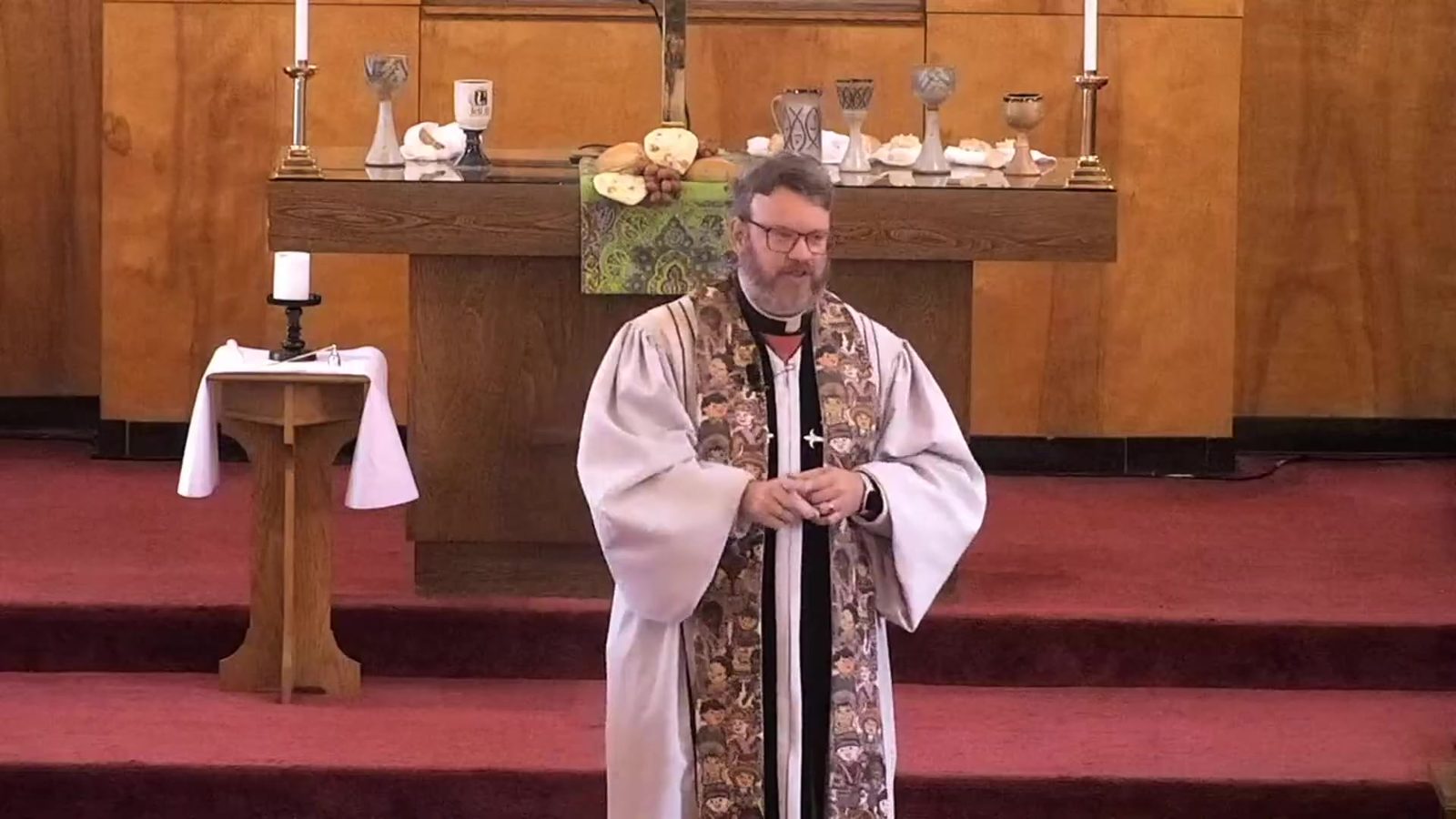
I think that is what is going on with the man who refuses to change his clothes in the parable. It is not really about wearing your Sunday best (for what it is worth, I am wearing a t-shirt under this robe right now). It is about a willingness to change, a willingness to be instructed, a willingness to hear what God is calling us to, even when it is not our way, or your way, or their way, but God's way. And God's way is wide enough, inviting enough, that it brings in so many people that it leaves every one of us with a decision to make: do I actually want to go to this table?
It is easy to look at the ones who said "I bought a farm, I have to go check on it," or "I bought some oxen," or "I just got married," and think, what is wrong with those people? They got invited to the feast of God and they did not go. Until we think about our own priorities, the times we have been invited to a table in our own lives and were too busy with our own stuff. This week, as I have been sitting with this story, I kept thinking about the times my son has said, "Hey Dad, come play a game with me," and I have answered that I had more important things to do. We have got stuff to do. As parents we cannot feel guilty all the time about that. But are we listening to the invitation? Are we paying attention to the world God is inviting us into?
This story is not about a one-time event, a banquet we attend once and then go back to our regular lives. When we accept the invitation, it is an invitation to be changed: by who else is welcome there, by the food and the cup offered to us freely, without anyone asking whether we deserve it. And when we are changed, we become the very servants who go out and invite others in. Not by telling people what they should think or believe (we still do not have it all figured out ourselves), but by our lives: by how we treat people, how we listen to those whose experiences are different from our own. That is how we show people whether they are welcome with us or not. That is really the question underneath whether we have put on the wedding robe or not. Are we living lives of welcome? Are we living lives that say, "I believe God loves you too, and I am going to find a way to make sure you know it, even when I do not like it"?
Not everyone is ours to invite, to be clear. It is okay to have boundaries, to say that person is not mine to bring to the table, while still trusting they are welcome here too. This is hard, honestly. Psalm 23, Matthew 22, Luke's version too, they all push. They challenge. They ask more of us than we think we can give. But here is the trade: we get to be at the table. We get to eat the feast beyond all feasts. We get to be part of a kingdom that will nourish us, care for us, help us grow. But we have to let go of insisting things go our way. We have to let God tell us, "here is a good place to lie down," the way a toddler who desperately needs a nap will insist on one more glass of water, one more story, anything but actually resting. Will we trust that God truly wants what is good for us, and wants it for everyone? All are welcome at this table. God's love is for all of us.