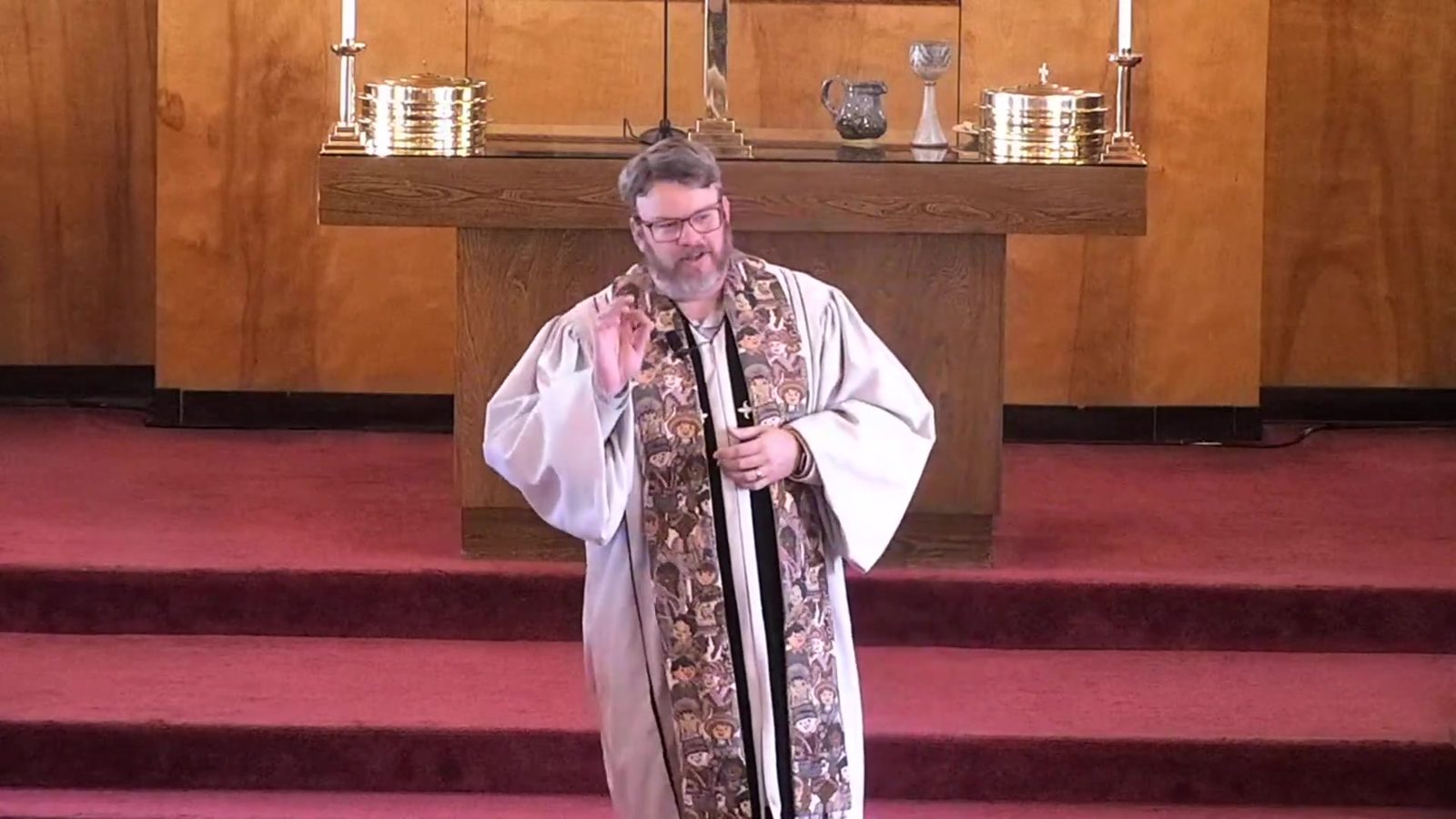
October 18, 2026
I'm basic.
I hear that's not something you're supposed to say. It's meant to be an insult these days. But a year and a half or so ago I was part of a cohort of preachers from across the country, all from the Christian Church (Disciples of Christ), learning about storytelling preaching. We were just getting to know each other. A couple of people knew each other, but mostly we were strangers, and our leader said, "Tell us something about yourself that other people don't know."
And I said, "I'm basic, I want to be basic, and I'm okay with being basic." I literally drive a white minivan. My prized possession is the Number One Dad mug that Oliver got me for Christmas one year. It almost made me cry. Most of the things I like are fairly basic things. That doesn't mean I don't have any eccentricities. I watch English soccer on Saturday mornings instead of college football on Saturday afternoons. But in general, I'm basic, I know it, and I'm pretty happy with it.
I have tried to be something other than that at times in my life. I wanted to be cool, or different, or a little bit edgy. I liked telling people I liked alternative music, when really I just go to Americana. We live in a world that tries to convince us to be something other than what we are. It tries to convince us to be like this group or that group, that the people we spend our time around are who we are supposed to be like. It is constantly seeking to mold us and shape us and make us.
When God gave the Ten Commandments and said, "Have no idols, no other gods before me," God understood something about the world and about us. The societies we live in and the groups we hang around with will shape and mold us. If we have other gods, if we let the group we belong to do the shaping, it will imprint itself on us more deeply than we think God has.
That is the question put to Jesus today. And I want to set the stage here, y'all. The Pharisees and the Herodians do not like each other. They really don't like each other. The Pharisees think the Herodians have dirtied themselves by associating with Rome, and not just associating with Rome but getting all of their power from Rome. The Pharisees believe their power comes from following the law and the prophets. They are enemies. But in this reading, a group of Pharisees has teamed up with the Herodians, because they have found a common enemy in Jesus.
They try to trap him by saying there are two ways in the world, the way of the Pharisees and the way of the Herodians. Which way do you fit in? And they ask it in front of the Herodians, in front of the Pharisees, in front of the crowds, and probably within earshot of some Roman soldiers: is it lawful to pay taxes?
If I stood up here today and told y'all to pay every cent of your taxes, stop looking for loopholes, and pay whatever the IRS says you owe, would I be very popular? Jesus wouldn't have been very popular with the crowds either if he had said, yes, pay all your taxes. Humanity hasn't changed that much. Except here is a significant difference: the taxes the crowds following Jesus had to pay went to an occupying government. They paid for the very army that was there to oppress them. They did not want to pay those taxes. And the Pharisees and the Herodians both thought Jesus was probably a little on the revolutionary side.
But if Jesus says don't pay your taxes, he has stood up to Rome. He has told people not to do what Rome told them to do, and the Herodians have the power of Rome on their side. They could have him arrested on the spot. It's a trap. Either he tells everybody to pay their taxes and becomes unpopular, and nobody follows the guy who said pay your taxes, or he says don't pay them and Rome takes care of him. Pretty good deal.
For the Pharisees and the Herodians, and for a lot of people today, everything comes down to whether we are in the in-group, whatever we want the in-group to be. Gaining the approval of people like us. Fitting in. Jesus has to worry about fitting in with the crowds who want revolution or with the Romans who have the power to kill him.
But Jesus shows us a different way. He shows us what it means to be made, and what it means to mold something. He says, "Bring me a coin. Let me see it." He looks at the coin and sees a head and an inscription. Jesus probably didn't read Latin, so he asks, "Whose name is this? Whose face is this?" And they say, "Caesar's."
So Jesus says, Caesar made this coin. It's Caesar's coin. Give it to him if he wants it. Caesar has imprinted himself on this piece of metal, and that's not mine. And that image will imprint itself on you. It's a warning for all of us: the images around us that try to control us will start to mold us and make us into their likeness.
He is pointing something out when he says to the Pharisees, "Bring me a coin." They are carrying a coin with Caesar's image on it. They are carrying an idol in their own pockets, on the temple grounds. They aren't supposed to be doing that, and the reason is that the image will start to shape and form and mold them. There are things in the world shaping and forming and molding us right now, making us into something we are not.
But Jesus doesn't leave it there. He doesn't just say it has Caesar's name and image on it, so give it back. If you found a shirt with somebody's name on it, you'd give it back to them, right? Pretty simple rule. He goes on: and give to God the things that are God's. If we know who something belongs to by the image on it, then we know what belongs to God. Ourselves. In the very beginning of the story, we hear that we as humans bear the image of God, each and every one of us.
We are called to give to God what is God's, and not to be formed by any other image. That doesn't mean we can't like things or have a life, because each of us bears an image of God that is unique to who we are. I'm not standing here telling y'all to go sell your cars and buy a white minivan. You don't have to be basic. You need to be who you are made to be. That is what it means to be rendered in the image of God: to know who you belong to and whose image you bear, and to let that image mold and shape and form you. Know that you were created by the one who made the heavens and the earth, that this one loves you and nourishes you, and let that love form you into who you are made to be, not who I am made to be.
The Pharisees and the Herodians, the leaders of this world, so often try to tell people, "You need to be what I think you need to be." We hear it constantly. You should do it like this. No, you should do it like that. Be like me. Think like me. Agree with me. Act like me. And all of that gets in the way of the image of God, which is trying to make us into who we are made to be.
In Paul's letter to the Thessalonians this morning, Paul says, you have followed in our likeness, just as we follow in the Lord's. But Paul isn't saying the Thessalonians are doing the exact same things he is. You know how I know? We have a bunch of letters Paul wrote. We don't have any letters from the Thessalonians. They weren't going around writing letters like Paul, or traveling as missionaries the way Paul did. What Paul means is that they are learning the love of God and letting it mold and shape them, just as Paul and Timothy and Silas were letting the love of God mold and form and make them.
And they are commended for it. The Thessalonians don't have to go out and tell people how great they are. Word is already getting around. Their light is shining in a time before social media, before cell phones, before the Pony Express, when traveling around a region was harder than anything we can imagine. Word is getting around about the church in Thessalonica because of their love and their willingness to follow the guidance of the Spirit, even in the face of persecution.
Y'all, when you try to be who you are made to be, you are going to face some persecution. You might be mocked. People might say, "You're so basic. Don't you like anything other than this?" People will tell you, "You shouldn't be like that. You shouldn't do that." The world is constantly trying to tell us we need to be something other than what we are. But the Thessalonians chose, just as Paul chose, to live differently, to be a church rooted in who God made them to be. And because of that, their witness traveled without them having to travel. Their testimony was making an impact on churches all around them, simply because they were living as who they were made to be.
I travel some in Virginia, and I know people around the region. Word about Unity gets around, y'all. We might not notice it because we're here, but here in the Radford community Unity is known, and throughout the Christian Church (Disciples of Christ) in Virginia, Unity is known. Not because we have a thousand people in worship. Not because we have a huge band. It's because this is a church living out what it is called to be. Are we perfect at it? Absolutely not. But we're growing in it. We have chosen to be rooted in God, and that means far more than anything else. We don't know what it might become or all the fruit it will bear. We simply keep being and doing what God has called us to be and do.
And we are a church where you can come as an individual and be you. Nobody here will tell you, "No, you need to act like the rest of us, dress like the rest of us, sing like the rest of us." Thank God we don't have to sing like each other, because I think y'all would have been done with me pretty quick. Instead, we get to be who we are, because we don't need someone standing between us and God telling us who we are supposed to be. We need to understand that we bear the image of God, we receive the grace of God, and we can become the people of God.
That is what we are called to, not just today but every day. It's why we gather for worship so regularly. We need reminders in this world of who we are, whose we are, and whose image we bear. Remembering doesn't happen automatically. It's not a decision we make once and then just keep going. Some hymns tell us, "I have decided to follow Jesus, no turning back." Not if you don't keep meaning it. I'm much more of a "Come Thou Fount" type: prone to wander, Lord, I feel it.
So we come back here to be reminded of the work of God. We sing together. We listen to the Scripture together. We hear the sermon. We pray. And at the center of it all, we come to a table where Jesus tells us, "Do this in remembrance of me." The table reminds us of the truth about who Jesus is and who we are, the truth of who God is, and that God will give us what we need, nourish us, and care for us, even when we don't feel like we deserve it. We are reminded of reality itself.
That coin they brought to Jesus, does anybody here know how much it was worth? It was worth whatever they said it was worth, because it's all made up. It's a piece of metal that carries Caesar's head and Caesar's name, and it's only worth what Caesar says it's worth among the people who agree. It isn't real. What is real is that which bears the image of God. What is real is us, and our belovedness in God. What is real is creation itself: the dirt and the grass, the crops that needed covering last night because of the frost, the grace of God that nourishes and sustains us.
We need to remember what is real and focus on what is real. That's not to say money has no part in our lives. We live in a system we have to be able to take part in. But first and foremost, we must remember what is real in this world, what is made by God and belongs to God, and live from that and be shaped by that.
If you forget, rub your fingers together. Feel the realness of your skin, of your body, of what God has done in making you, and remember that the same God who made you is providing for you in real ways and shaping you in real ways, inviting you again and again to receive the real grace and love on offer. If you need another reminder, find somebody you can reach out and touch. Just ask first, because otherwise that gets weird.
Find that realness. Remember what God has done and will keep doing. Live through your week with that reminder, knowing the real love of God is present at all times and that God is providing and will keep providing. And as we live out who we are called to be, we will proclaim that realness to others and invite them to know the love, the goodness, and the grace of God. Amen.