September 27, 2026
“You mean Ben is going to be a minister?”
That was the question one of my mom’s teaching colleagues asked her after I felt called to ministry. This teacher had a friend of mine who was her son, someone I’d graduated with. We knew each other well. She knew me very well.
And her response to me being called to ministry was, “You mean Ben is going to be a minister?”
It was a very reasonable question. Without going into too many details, I’ll simply say I may have crossed the behavior line in terms of being a little too wild in high school. Never in jail, but you know, that might have been luck as much as action.
You mean Ben is going to be a minister?
There are a lot of people who knew me when I was younger who may have a hard time seeing me holding any kind of religious authority. And you can’t really blame them. Where does your authority come from? Those people knew me in my teenage years, and most of us probably have stories from our teenage years that would seem to preclude us from certain kinds of roles, or authority, or whatever else.
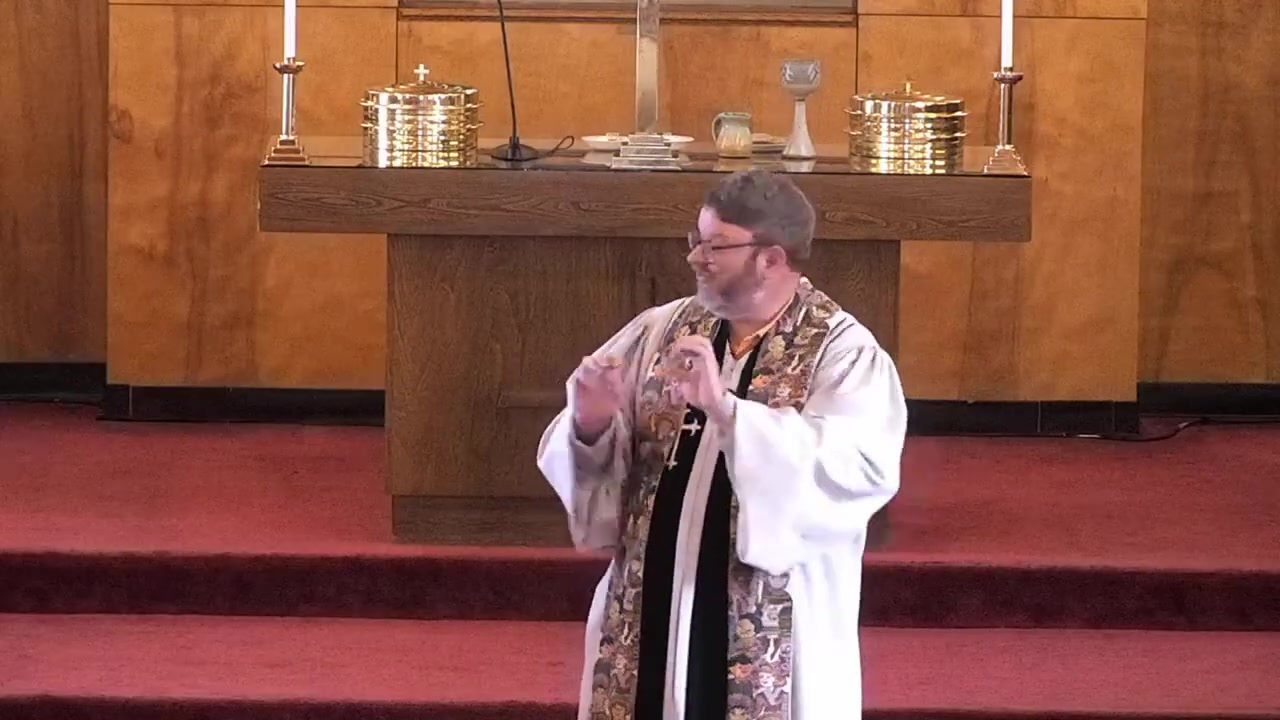
You all met me like this: wearing a robe and a stole, looking like I know what I’m doing, at least on occasion. Where does my authority come from? To start with, when you met me, it came from the stole and the robe. But there is a much deeper form of authority. A much deeper form of authority that each of us actually has within us, if we are willing to live into it. An authority that moves beyond what we wear, how we look, how we act, even what we think or believe. And it’s the kind of authority that oftentimes we don’t really look for. We don’t really look into it.
It’s the same kind of problem that the chief priests and the elders are having with Jesus in today’s scripture. They are looking for a kind of authority that they can recognize. And Jesus, in responding to them with his question, shows the only two kinds of authority that they recognize. Where did it come from? And they say, well, our opinion is this, but the crowds think that. And we can’t go against our own opinion, and we can’t go against the crowds.
How many of us see authority in this way? Either this person agrees with me. This person thinks the way I think, and therefore they are right and they are righteous and they are good. Or this person is popular, and the crowds like them, and so they must be good. They must know what they’re talking about.
How many of us see authority just through those two lenses: agreement or popularity?
We’ve got our own cautionary tale within the Disciples about the popularity side. Some of y’all may not realize it, but within the Christian Church, Disciples of Christ, none other than Jim Jones was one of our ministers at one point. Popularity does not mean there should be authority given when other things do not exist. But oftentimes we also look for those who agree with us, who say what we want to hear, who measure up to our opinion of what they’re supposed to be, in order to say they get authority. I agree with them. They think what I think. So they must be good. They must be right.
In both cases, we elevate something to authority that is lower than the authority we are called to seek as followers of Jesus Christ.
Did you notice what was missing in the argument, in the debate that the chief priests and elders had? What was never said? Do we think that John came from God? Do we look for the signs that John may have been a prophet, may have been guided by God?
The chief priests and elders were a particular sect within Judaism of the first century. Their authority came from the temple. Priests in those days weren’t called. They were born. You belonged to a certain lineage, and your authority was handed down to you by your father, and your father’s father, and your father’s father’s father, and therefore they should have authority. Their authority was seen as their right of birth, and so they got to determine, in their own minds, who belonged and who didn’t. Literally, they got to tell people in the temple: you can come in this far and no further. Your sacrifice is either good enough or you need a better one.
They were authorities, and their question is, where do you get off, Jesus? We know where our authority comes from. We fall within the priestly lineage. We deserve this.
But because they had an assumed kind of authority, they never actually developed the curiosity to respect that God might be doing something outside their own understanding, outside their own control, outside their own authority. And they’re not just asking Jesus abstractly, where do you get off, where does your authority come from? The priests and the elders are coming to Jesus the day after he cleansed the temple. He came into their place, turned over their tables, drove out their sacrifices, drove away their money changers, their system, their way of doing things. Their authority itself had been questioned by Jesus.
And I’ve got to be honest with y’all: I think we probably would have reacted more like them than the crowds. Imagine an outsider comes into our place and tells us we’re doing things wrong. Aren’t we going to want to know, where do you get off, where are you coming from, that you think you get to tell us?
It doesn’t mean that just because somebody comes from the outside (let’s be very clear here) just because somebody comes in and does something crazy, that is also not a form of authority. Instead, what we are called to be and to do as followers of Jesus Christ is ask a question that they never asked. A question that oftentimes we may forget to ask.
Where is God in this?
In this moment, in this day, in this life, where is God? Because that is where true authority comes from. Do we look for it? Do we seek out what God is up to in the world? Because it really and truly might look different than the way we do things, the way we have chosen to act and behave, and even believe. It may push the limits of what we think is in fact possible.
And so next time you’re in the middle of a decision, or in the middle of a disagreement, or in the middle of something, and you’re trying to figure out what’s good, what’s right, what’s best, lead with that question. Where is God in this?
As followers of Jesus Christ, we are supposed to choose a different way. A way where we are not in control, where we are not in charge. I talked about the authority that I receive simply by having “Reverend” in front of my name, having the stole, having the robe. By the way, Ben wants this stole, and I’m thinking about giving it to him. Bad news for Mary Lee and Nick.
But the stole doesn’t make Ben right. It doesn’t make him good. His goodness comes from God. And we need to learn to seek that, to ask for that, to find that, so that we can let go of our own need to control, to manage, to manipulate, to force our way. Instead, we need to be changed.
Because the central question this morning, where is God in this, was never asked by the chief priests and the elders when they saw John the Baptist in the wilderness. They didn’t believe him, and therefore they did not do what he was calling people to do.
Do y’all remember what John called people to do? Repent. Change. Move in a different way in the world. Leave behind this way of being and doing things. Yes, the tax collectors and the prostitutes needed to change their own need for control. But there was no one at that time who more needed to hear let go of your need to control than the chief priests and the elders.
Are we willing to listen to that call to repent, to say God is at work, and God’s work looks different? It is different in this world than the way we’re used to doing things. We like getting our way, right? And sometimes there’s a part of our brain that’s always going to be there saying, you know, if I do this, it’s good and it’s right, but maybe it’ll also benefit me. Maybe it’ll also make things happen the way I want them to happen.
But the call of Jesus is to live into a freedom that moves beyond our own need to control, to manipulate, to make things exactly the way we think they should be, and instead live into a way of mutuality with one another, but especially mutuality with God. Trusting that God is at work, and that though God may not be up there moving all the chess pieces on the board, God is instead moving in the ways of love that bring about redemption, that slowly but surely move goodness to the forefront, shine light into the darkness, and will overcome the powers of evil and death itself. Not through manipulation and control, but through light and goodness, redemption and conversion, repentance and renewal. These are the ways of God.
We don’t force anybody to repent, right? We invite them. We trust that God’s work is enough.
Paul, in Philippians, says to the Philippians: “Y’all be of one body. Be of one mind. Be of one heart.” Not, you’ve got to agree on everything (only allow authority to be that which you agree with) but instead, want the same things. Want goodness, want light, want the kingdom of God to come. What we pray for week after week.
We have to believe in those things, and trust that each person in here, even when we don’t agree with them, even when we think they are the wrongest person who has ever been wrong in the history of the world, still wants it. Still wants goodness. Still wants love. Still wants the kingdom of God to come into this world, because it is that work which will help us to be redeemed. It is that work which will show us where we need to repent. Show us where we still want control, where we still think we have to be in charge for good things to happen. It’ll hold up a light and a mirror to us, to challenge us to say, are you really of one mind? Do you really trust that the person right here in front of you wants the same kind of goodness you want, even if you disagree?
That is the power, and the beauty, and the strength of a church like Unity: that we can disagree with each other and still say, I know that you want goodness. You want love. And in fact, I have enough humility, enough of what Paul calls fear and trembling. This is not like a horror movie. I know we’re heading into spooky season, y’all, it’s not that kind of fear and trembling. It is a humble fear and trembling that says, I know I don’t have it all figured out, and I don’t have to. Instead, I have to continue to work, to allow my heart and my mind to be challenged and pushed and changed and worked on toward goodness.
This is what it is to be a follower of Jesus Christ: to work it out with fear and trembling. To trust that God is at work, and that we don’t have to have it all figured out. We don’t have to have it all right. Instead, we have to have respect for the work that God is doing in the world. Trust that even when it’s not the way we want it to be, God is still moving. The light is still shining. The darkness and the evil will not win.
Spooky season is actually a beautiful thing, because we can face the very things that we think we cannot overcome, and know that God is with us. Whether it’s a child with a fear of the dark, or an adult with a fear of the dark, or whatever it might be, we can know that God is at work. We can know and face the things that seem too much, because we know where God is. We know that there is an authority so much greater than anything we have ever encountered before. That there is a love that can cast out fear. A light that the darkness cannot overcome. A life that even death cannot constrain.
But we have to believe this. We have to trust this. We have to ask that question: where is God in this? What is God up to?
It is a curiosity that allows us to really and truly live into the depth of the word disciple: student, learner. May we have the curiosity, as we go back out into the world, as we live our lives, but as we work as a community, to say, what is God up to here and now? And the respect to allow God to speak differently than we may expect. To allow God to show us a different way than we may have experienced previously. To allow love to expand our hearts and our minds, to work out salvation itself with a fear and trembling that knows God is present.
May we have that respect for one another, and for the work of God. When we do that, we will see things and experience things that we never imagined, so much more than we could have ever hoped for.
What is God up to? May that question light your way every step you take.
Amen.