July 5, 2026
He was a sheep in wolf’s clothing.
Yeah, that’s a little bit backward, but it’s a story from C.S. Lewis. It’s at the very end of The Chronicles of Narnia.
It’s not actually a sheep in wolf’s clothing. Instead, it’s a donkey in lion’s clothing, but it’s the same thing.
At the beginning of the last book of The Chronicles of Narnia, a scheme is hatched.
Aslan, in The Chronicles of Narnia, is a lion who represents Jesus Christ in the world of Narnia. But Aslan has not been seen in Narnia for a long time.
Some of the animals decide that they need a little more control. They need a little more power.
A monkey convinces a donkey to take a lion’s skin, put it on, and randomly appear around Narnia. He never gets close enough for anybody to inspect him and realize that he is no lion, and certainly is not Aslan, but he appears just enough.
Then, the monkey claims to be Aslan’s spokesperson.
The monkey is determined to have some control, so he tells the donkey to do this and do that. Eventually, the people and the other wild animals of Narnia, all of whom can talk, start to believe that Aslan has returned and that this monkey is his spokesperson.
They’re obviously wrong, and they don’t know what is happening.
In fact, another god gets wrapped up with Aslan, and he becomes Tashlan, which is Tash and Aslan, even though they are very different in terms of who they are as gods.
But the people hadn’t seen Aslan for so long that they forgot what he was like. They forgot what Aslan was like, except that they remembered one phrase about him:
“He’s not a tame lion.”
It’s a phrase that meant Aslan can do whatever Aslan wants because Aslan is God, or at least God’s son. They interpreted “He’s not a tame lion” to mean that anything goes because they had lost their familiarity with Aslan.
When that phrase was originally said, it was not meant to say that you can’t know who Aslan is or that you can’t know anything about his character. It was meant to say, “You can’t make him do what you want him to do.”
That is literally what the monkey is getting the donkey to do:
“I’m going to tell Aslan what I want, and then Aslan must do it.”
But the people of that time had become so unfamiliar with Aslan that they had forgotten.
They had forgotten what his goodness looked like.
They had forgotten what his grace looked like.
They had forgotten what his hope looked like.
They no longer had the new life that they had once found through him.
Peter, in the letter that we read this morning, is trying to remind his readers that though they don’t see Jesus, they believe in him. Though they have never seen Jesus, they walk with him and stay with him.
It is in that process that, first, we are reminded who Jesus is and what Jesus is about. But it is also in that process that we find true freedom and true life in him, rather than some sort of mimicry.
I mentioned the sheep in wolf’s clothing because I think that’s many of us sometimes.
Do you ever lash out because you don’t like something?
Do you ever get a little snappy or just not act like yourself because you’re trying to make something else happen?
When I first read this particular book of The Chronicles of Narnia, I remember thinking, “This is just so absurd that this monkey would think he could dress a donkey up as Aslan just to get what he wants.”
But how often do we dress ourselves up as something we are not to try to get what we want?
How often do we become a sheep?
That is a quick reminder of what Jesus calls us as his followers. I know it’s not a popular thing to think of yourself as these days, right? You don’t want to be a sheep. Sheep are seen as negative, weak, or dumb.
But Jesus calls us sheep.
I’ve actually seen, right next to some sort of Christian bumper sticker, another bumper sticker that says, “Lions, not sheep,” because we’ve forgotten who Jesus is and what Jesus calls us to be.
We end up trading our opportunity for good and abundant life for some cheap knockoff, walking around in somebody else’s clothes, doing somebody else’s work, and thinking that we can somehow make things the way we want them to be.
If only we have more power or more control.
If only we can convince the people around us to listen to us.
Actually, being a prophet for God sounds pretty good, right? If everybody thinks what you say comes from the mouth of God, you can say whatever you want.
There’s a caveat there. You have to not believe in God because, if you believe in God and you start putting words into God’s mouth, you know you’ve got a problem, right?
The freedom that we are offered through Jesus Christ, and the life that we are offered through Jesus Christ, which we see described here in the letter from Peter, is a different kind of thing.
Peter starts by reminding his readers that their new life came not through Jesus getting what he wanted. That community had heard the same stories we have heard. Jesus goes to God and says, “Let this cup pass from me,” and it doesn’t happen.
Instead, that new life came from God’s redemptive work of overcoming suffering, pain, and even death.
It is that which grants us true freedom and new life.
Peter then reemphasizes this point by saying, “Look, you’re going through your own sufferings now, but you can also have joy.”
He doesn’t say that God is going to make your suffering go away. He doesn’t say that God is going to make whatever you want happen.
Instead, he says, “Yes, you are suffering, and it’s okay to name it.”
It is not God’s will that you would suffer, but suffering can happen. It is indeed a part of our lives. God knows our suffering and hears our suffering, and God is still at work.
Even when things don’t go the way we want them to go, even when the temperature says 100 degrees day after day after day and your garden is wilting, God is still at work.
God is still present and doing things.
That new life is available to each of us.
Here is what it looks like. Peter says that the hope we have cannot be damaged. It cannot be destroyed by any kind of suffering.
That is not because we have this great ability to hope.
Does anybody in here ever feel a little hopeless?
It’s all right, y’all. This world is hard and terrible sometimes. It is also beautiful and good sometimes.
We will all feel hopeless sometimes.
We don’t have to hold on to hope. Hope holds on to us.
We don’t have to cling to hope by our fingernails. Instead, we have to trust that the hope of God is enough to hold us and carry us, even when we feel hopeless, even when we face darkness, and even when we are suffering.
When we think we have to hold on to hope, we’re trying to carry it. We’re trying to make things happen the way we think they have to happen.
But when we allow hope to hold us, it frees us to live a life in which we can enjoy the little moments.
I mentioned gardens earlier. Is anybody getting some stuff out of your garden?
How’s that first bite?
It’s pretty good, isn’t it? There’s nothing like the first bite from the garden.
Except, I grew some banana peppers that are about 8,000 on the Scoville scale, not realizing exactly how spicy that was. The first bite was really sweet until my mouth was on fire.
But we miss out on those little joys when we think we have to hold on to hope.
We miss out on the goodness of life, the joy of life, and the celebrations of life when we think we have to make things go the way we want them to go. We think we have to manipulate circumstances to make them what we believe they have to be.
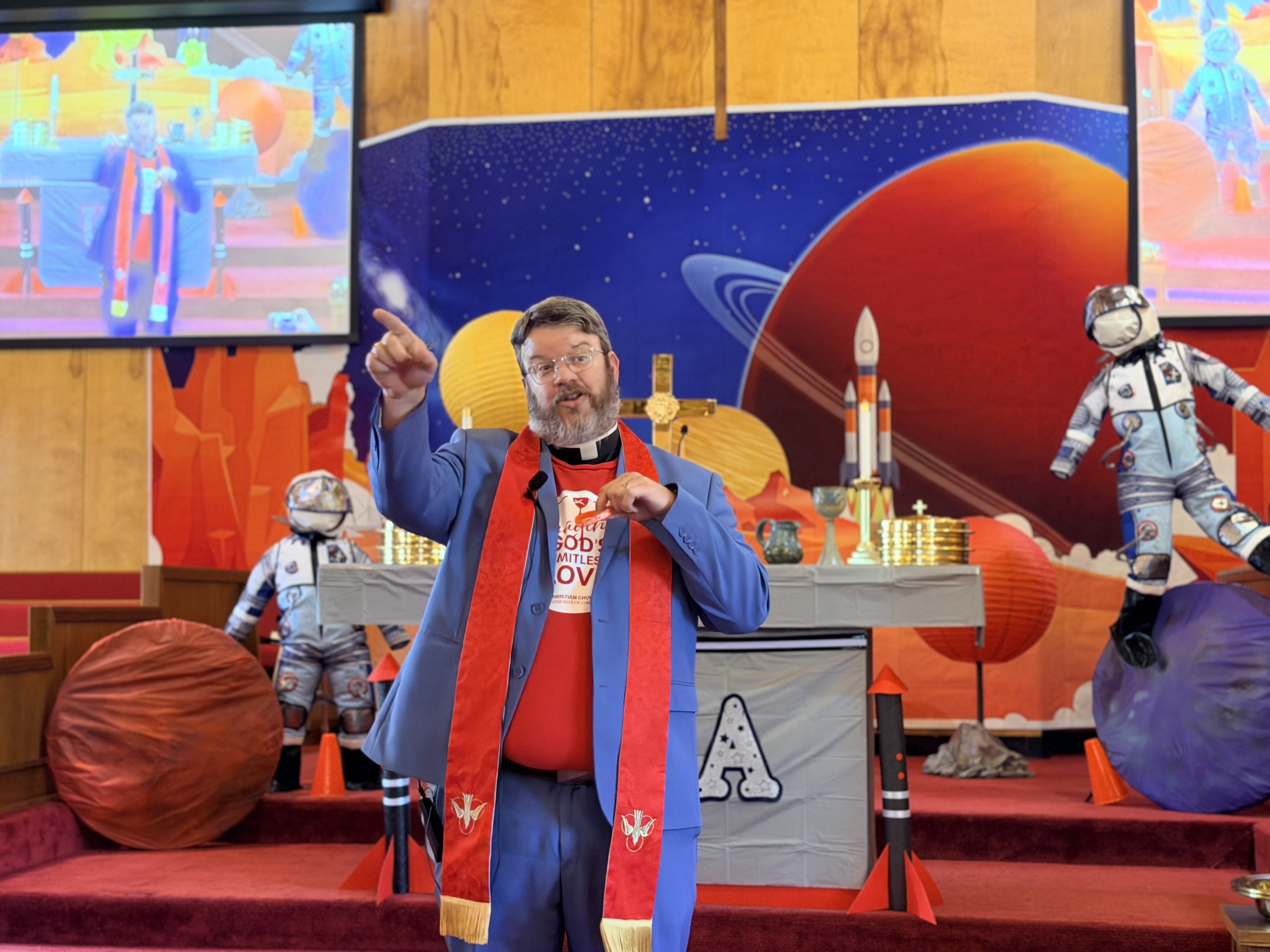
During Vacation Bible School this past week, the kids reminded me that Bible story time is not going to go the way I plan, and that’s good.
We had so much fun and so much joy during that time.
We cheat ourselves of the life that Peter tells us we have been given as a free inheritance by thinking we have to earn it.
We cheat ourselves of the goodness of the new life that God has offered us by thinking we have to be the ones who keep it under control.
We cheat ourselves of the abundance of God’s grace when we spend our days trying to decide how things should be instead of enjoying the things that are right in front of us.
Life is here. It is a gift.
That’s what an inheritance is, right? The beautiful thing about an inheritance is that we don’t work for it.
We are simply given it.
Will we accept that goodness?
It doesn’t mean that we don’t ever do anything or work for anything. I’m talking about gardening, y’all. If you were outside in your garden this week, you know that it is not easy.
But it is good.
It does require something of us, but not in such a way that we have to do everything.
It allows us to do our small parts.
Tying up tomatoes, watering during the heat, and pulling weeds are little things. We know that, with the help of those little things, the garden will grow. It will bear fruit, not by our power, but by the goodness of the soil and the rain that comes down from heaven.
Y’all, if we don’t have rain, does your garden grow, even if you water it?
Not much. Not much.
It is by the grace of God and the goodness of God.
That is the same thing we are offered here: an imagination that things so much bigger than us contribute to the good life.
The goodness of life does not come only through our control or our efforts. It comes through the combination of the pieces we can do and the grace and goodness of God that are offered freely to each and every one of us.
That is right here, right now.
If only we will accept it and receive it.
When we imagine a world with more, we must imagine a world that is more than us.
Who here loves sitting at the ocean or under the mountains?
One of the things that I think we, as humans, love so much about it is being near something that we know is so much larger than us.
A reminder of our smallness allows us to be fully and truly who we are. It allows us to shed the wolf’s clothing that we think we have to wear to have a good life.
Instead, we can live as the sheep who are cared for, fed, and nourished by a good shepherd.
We can live a life that is true and full, recognizing our own roles and God’s role.
It doesn’t mean we can’t do anything, y’all.
How many people do we think ate last week simply because of our efforts?
At least 115.
But let me tell y’all, that little red box has fed a whole lot more. I’ve watched it fill and empty, fill and empty.
How many people do you think have learned about love simply by being in your presence?
Those of you who volunteered at Vacation Bible School, how many kids now know that this is a place for them simply because they can come here and be who they are?
Perhaps you reached out to somebody last week just to check in, to take them some food, or to say, “How are you?”
Those things make a magnificent difference in this world.
Each and every one of you.
Each and every one of you sitting here in the sanctuary or watching at home.
Each and every one of you is fearfully and wonderfully made by the same God who made the universe.
The challenge before us is simply to live into who we were made to be.
Nothing more and nothing less.
If we can do that, we will know the goodness of God.
We will know that, yes, in fact, life is good.
Amen.