June 7, 2026
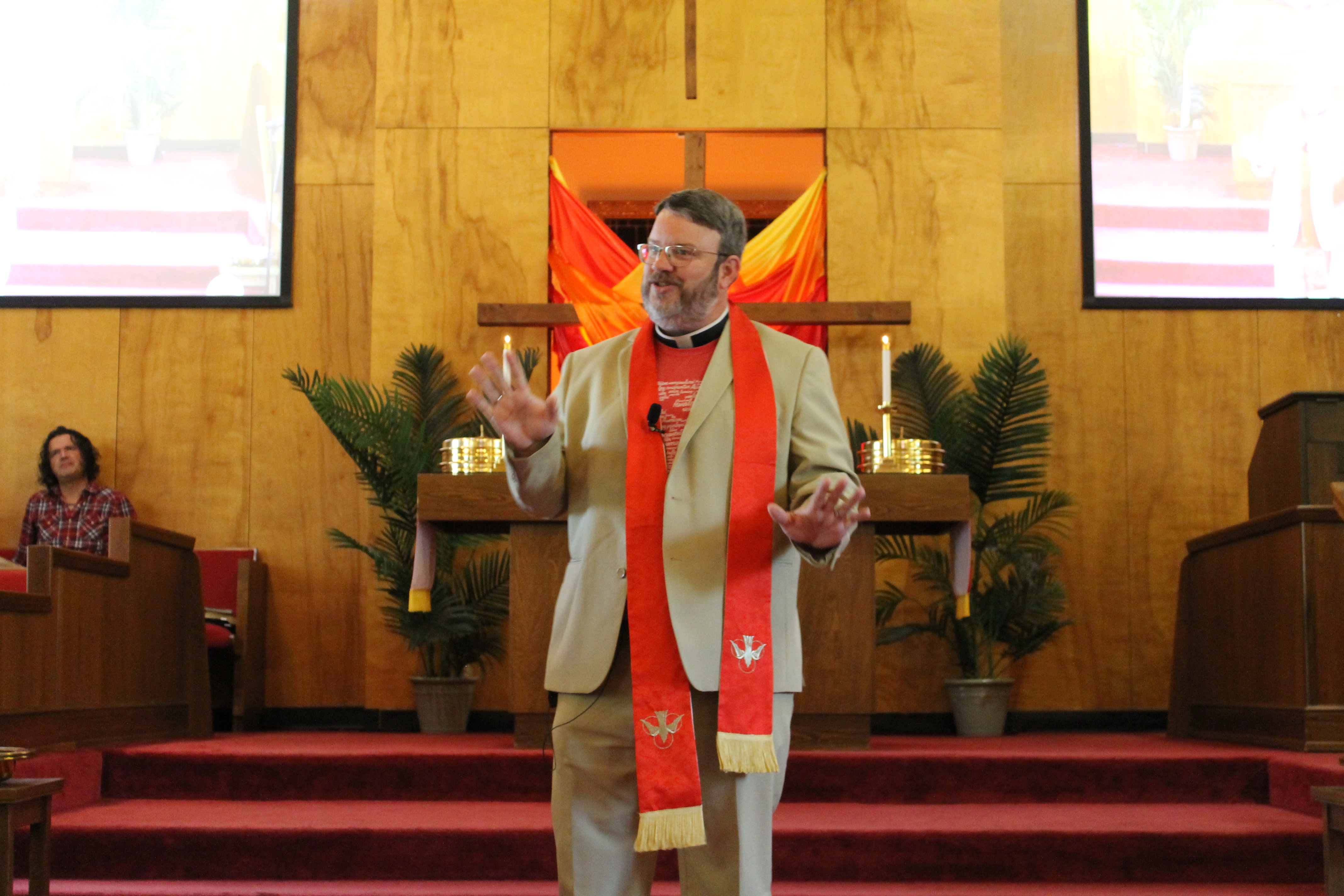
Raise your hand if you are a fan of Virginia Tech.
Raise your hand if you're a fan of UVA.
I like the bravery. Raise your hand if you're a fan of both Virginia Tech and UVA.
Okay, raise your hand if you are a Swiftie, a fan of Taylor Swift.
Raise your hand if you are raising a garden this summer.
Raise your hand if you like to eat tomatoes.
Yes, pizza sauce counts. You can turn tomatoes into pizza sauce.
Raise your hand if you were born before 1970.
Raise your hand if you were born after 1970.
Raise your hand if you drove farther than 10 miles to get to church today.
Raise your hand if you drove less than two miles to get to church today.
Raise your hand if you've had a disagreement with someone this week.
We've either got some people not telling the truth, or who are incredibly agreeable.
I didn't say argument or fight. Just to be clear, you didn't disagree with anybody this week.
That’s an incredible week. I can't get through a day without disagreeing with myself. So, good job to y'all.
Raise your hand if you're glad to be here this morning.
Did everybody raise your hand if you haven't raised your hand yet?
All right, good. I got everybody.
We all come from different backgrounds, from different experiences, from different preferences.
For the first 40 years of my life, I couldn't eat a pickle.
Raise your hand if you like pickles.
Look at that. That's almost as many people as are happy to be here this morning.
I couldn't eat a pickle because I worked in a vinegar bottling factory from the time I was 12 until I was in my early 20s. No child labor law problems. My uncle owned it, so I'm allowed to do that, right?
And when you work in a vinegar bottling factory during the summer, and it's not air conditioned, and you're bottling the vinegar at over 150 degrees, there ain't much that has vinegar that you like.
Vinaigrette dressings, pickles, none of it.
It took me two decades to get over that distaste for anything vinegar to the point where now I'll eat a pickle and be okay.
I was telling that story a couple of years ago when I was at Craig Springs, and another guy who's probably 10 years older than me said, “I worked in a vinegar bottling factory in Roanoke when I was a kid.”
And I said, “What? What are the chances?”
I said, “Who owned it?” because I'm doubting him.
He said, “Glenn Dunville.”
I said, “That's my uncle.”
He had worked there the first couple summers my uncle had it open, and then after that, I had worked there.
We had never crossed paths working, but we had grown up going to the same church, to Westhampton Christian Church in Roanoke, where we were both baptized. His dad had taken me golfing not long after my grandfather died.
But David and I had never really run into each other. So much so that I wasn't even aware that he had worked for my uncle for a couple years.
Little threads like that connect us in ways that we never expect or never know.
And we have to remember that when we start thinking about community, the things that connect us, that tie us together, that mean that we do not rise or fall alone, so that we can work on our hopes for each other, for our community.
One of the things I've noticed here at Unity over the last several months is a deep desire, and I believe this is to a person, a deep desire for this community to love each other.
That is something that is a priority here.
Doesn't mean we always get it right. It doesn't mean that we always act in ways that are loving, but it needs to be named as a priority for this congregation.
That there is a deep desire here to love and to be loved.
This is a desire that I believe comes from the Holy Spirit, a gifting that God has given to this church to be a sign of what Jesus said we are supposed to be known by: our love for one another.
When we read the Acts text this morning, we see that same love in the earliest versions of the church, that there was a desire to act from, learn from, and grow from love.
They were dedicated to a common teaching, the teachings of the disciples.
Now, I want to be clear here.
That doesn't mean they all agreed with the takeaways, right?
Y'all think that there were a couple thousand people learning the same thing and they all agreed with each other?
Not going to happen.
That's a negative.
But they dedicated themselves to the same teaching, the teaching of Jesus Christ as Lord and Savior.
They continuously dedicated themselves to that teaching, to fellowship, to spending time together, to growing together, to learning together, and to prayer.
That is what it looks like to be a community rooted in love for each other and for the same thing.
It says that they held all things in common.
And I know there are many of us that hear that and go, “Ooo, that sounds like a commune or some sort of hippie-dippy crazy thing or communism itself.”
But holding things in common is a different thing when we choose to do it together as a community.
It means that we see things not as mine, but as ours.
Whose sanctuary is this?
Ours. God's.
There's a little tension there.
It is ours and God's.
And this is the place where we learn, where we worship, where we pray together. We hold this in common together with God's help.
And we don't just hold possessions in common.
We hold a belief in common, a belief in Jesus Christ.
We may not agree with each other on everything. In fact, we may not agree with each other on a whole lot, but we start here every single day, every single moment, that each person in here who has said, “I believe that Jesus Christ is Lord and Savior.”
Jenna hasn't said it yet. I think she's got about two more months.
She's getting there.
But everyone who has confessed Jesus as Lord and Savior, we have to start with a trust in one another that we are all trying to live that out.
We're all fallible. We're all going to get it wrong at times, but that is where we start.
That is what we hold in common.
And then we work together.
Alexander Campbell, one of the founders of the Christian Church, Disciples of Christ, talked about this idea of common sense.
You ever say that person's got no common sense?
You ever say it to the person in the mirror?
He wasn't talking about that kind of common sense.
Instead, he was talking about a common sense that is brought together by the community, a sense that is held in common.
In a world in which we have become more and more divided, more and more individualized, this is radical, that we come together to seek a common sense.
Not that we are going to come to agreement on everything, but where we can say, you know something, there are people who are hungry and they need to be fed.
And so we do Community Table, and we do the little red box, and we start looking for other ways.
Are there other things that we can do together to help people be fed?
We look around and we say, “There are people who need undies and brazies.”
And we say it from the front of church, y'all.
I love that.
And we gather them so that people have what they need.
We look around and we say again and again, we together as a community hold in common that part of what we are called to be about is helping people.
Whether that be people outside our doors or helping people right here, right now, those kinds of things are signs and wonders.
In Acts, it says that the apostles did signs and wonders.
But Jesus didn't say we would be known for walking on water.
Instead, he said we would be known for our love.
Those are the signs and the wonders that this world needs to see: that there are people that in spite of disagreements, in spite of differences in backgrounds, in spite of so many things, are willing to keep trying to love each other.
Keep being willing to make the sacrifices and show the commitment that is necessary for us to shine God's light into the world, to bless each other in our endeavors, and to recognize that we hold in common that we trust that each of us wants goodness in this world, wants goodness for those around them.
Because the best news of Jesus Christ is it isn't dependent on me being right and proving you wrong.
The good news of Jesus Christ is instead that the Spirit can take our willing hearts and our willing minds and guide us to do good in this world, even when we hold bad opinions, even when we get things wrong.
Because that is the way that God works.
The Spirit did not come on that first Pentecost that we celebrate and give them all the right opinions.
Nor did it wait for them to have all the right opinions.
Instead, it came and showed them how to proclaim good news, to live out love for all people.
And that is what they dedicated themselves to, and to breaking of bread.
They ate around tables together.
Raise your hand if you go to BT's a lot of times after church.
I'm telling you, that's it right there.
That is part of discipleship.
It seems so simple, but as much as we can do our devotionals and read our studies and become intelligent, even if you've got a Master of Divinity degree — no offense, I know there are several of us in here — it means nothing if we don't sit at tables and break bread together to learn and to grow together, to share from each other's experiences so that we can listen to each other.
I want to give y'all a little piece of homework this week.
I don't give homework every week, but every once in a while I need it, and so I give it to y'all, too.
Find one conversation where your primary role is listening and watch how it changes your brain.
Because I've got to be honest, I'm always listening to respond.
Anybody have in mind what they're going to say before the other person starts talking?
We have been trained by our society to constantly be ready to reply rather than to simply listen and accept.
My story is not your story.
I cannot know what it is to walk through the world as you have walked through the world, and the reasons that that has taught you what you have learned.
And the same thing is true in reverse.
This is what it is to be community, to learn that other people have experienced the world differently but come to the same place.
When we celebrate together as church, we get to see a more multifaceted, a broader and more beautiful world.
Has anybody ever told you, “Hey, go look at the sunset”?
Were you looking at the sunset before they told you?
Sometimes, but oftentimes we're not.
Oftentimes it's somebody else catching a glimpse of beauty telling us it's our turn to go catch that glimpse.
And even then, we don't necessarily see the same thing.
A sunset is not the same 30 seconds later. The colors have changed just so.
And also, how do you all know that when I say the word orange, you're seeing the exact same thing I'm seeing?
We don't.
Because we all see and experience just a little differently.
But we can still call to each other.
Say, “This is what I'm seeing. This is what I'm understanding. This is what I'm hearing.”
And in so doing…
Who here is growing a garden?
Does anybody plant the three sisters?
Anybody familiar with the three sisters?
What are they?
Squash, corn, and green beans.
They work together.
They each need something different and each get rid of something different.
The squash provides shade to the beans so they don't get burnt up when they're too young.
The beans provide nitrogen to the ground.
The corn provides a solid thing for the string beans to wind their way up.
They are all providing for each other in spite of being entirely different.
We need each of us, every single one of us, to be the community that we are.
And then there's that promise at the end.
If we simply are that, devoting ourselves to the teaching of the gospel, to breaking bread and fellowship, and to prayer, God will add to the number.
That's not our work.
People will want to come where the soil is good.
You ever notice the weeds grow in your garden, too?
That's because you have good soil.
Get rid of the good soil, you won't have any weeds.
You won't have any garden either.
But people want to be where there is goodness, where there is love, where there is diversity and understanding, where the soil is good.
That is how we grow.
That is how we bear fruit.
That is what the earliest church sought to do.
Y'all, they didn't get it right all the time.
It doesn't take long before in Acts, they're arguing with each other about all kinds of different stuff.
And those are only the things that they recorded.
We don't usually write our arguments down, right?
But they were trying.
And that is what we are called to do as well.
To remember that a priority here is that we can love each other.
That we can receive love from each other.
That together we are so much more than we are alone.
When we imagine a world with more community, may it never look like more of me, like more of any of us as individuals, but instead look more like the beauty of a community that is different.
That brings experiences and thoughts and ideas that we'd never have on our own.
And may we always be a sign of wonder for this world.
That love is so much more than the things that seek to divide us.
That love as the root of the community can do what nothing else can.
And we will learn that we too rise, that we are all connected together.
And when we allow those connections and that love to lift, it lifts all of us so that God's abundance may be visible right here.
Let us be that beloved community as we continue to imagine God's more beautiful, more full, more abundant kingdom coming here on earth.
Amen.